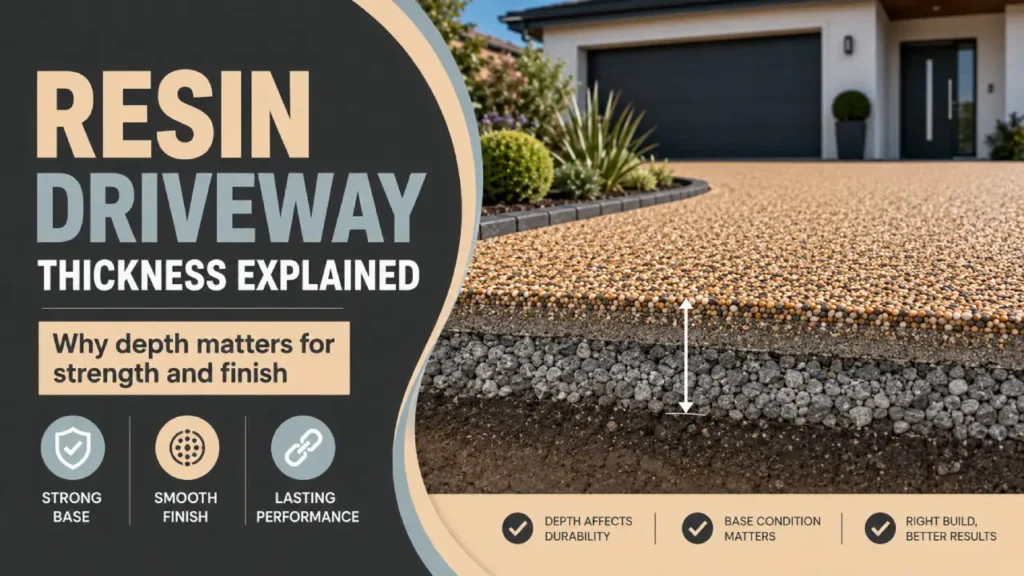
For a typical domestic driveway used by cars and light vans, a resin bound surface is commonly laid at 18mm thick over a stable, correctly prepared base. Paths and patios may be installed at around 15mm, while areas exposed to heavier or more frequent vehicle traffic require a project-specific specification.
That answer sounds simple, but resin driveway thickness should never be considered on its own. Aggregate size, expected loading, base construction, drainage and the selected resin system all affect how the finished surface should be designed.
Resin Driveway Thickness at a Glance
| Area or use | Typical resin-bound depth | Important consideration |
|---|---|---|
| Garden paths | Around 15mm | Pedestrian use only |
| Patios | Around 15mm | Depends on the approved system |
| Domestic driveways | Around 18mm | Common for cars and light vans |
| Heavily used parking areas | Project-specific | Base and loading must be assessed |
| Commercial vehicle areas | Engineered specification | Adding resin depth alone is insufficient |
| Tree pits | Often considerably deeper | Different construction from driveways |
DALTEX recommends a minimum depth of 18mm for its manufacturer-approved resin-bound installations. SureSet also describes approximately 18mm as a typical depth, although it confirms that the final figure depends on the application and aggregate size.
Why Is 18mm Common for Domestic Driveways?
A resin bound surface is made by coating graded, kiln-dried aggregate with polyurethane resin. The mixture is then spread and hand-trowelled over a suitable base.
At the correct depth, the material forms a consistent layer with enough aggregate contact and resin coverage for normal domestic traffic. It also gives the installer sufficient material to close, level and finish the surface without leaving thin areas.
A surface laid too thinly may be more vulnerable to:
- Loose aggregate
- Weak patches
- Uneven texture
- Premature wear
- Visible base irregularities
- Failure to meet the manufacturer’s specification
A deeper layer is not automatically better. Excess depth may affect material quantities, permeability and curing, while doing nothing to correct weaknesses below the surface.
Is 15mm Thick Enough for a Resin Driveway?
Some resin systems and online calculators refer to 15mm as a possible minimum. However, several established manufacturers and aggregate suppliers recommend 18mm for vehicular installations.
A 15mm layer may be appropriate for a path, patio or lightly used pedestrian area when it follows the chosen system’s specification. It should not automatically be accepted for a driveway simply because it uses less resin and aggregate.
Before accepting a quotation, ask the installer to confirm:
- The proposed finished depth
- The aggregate size and grading
- The resin manufacturer and product
- Whether the system is approved for vehicles
- The expected coverage from each mix
A quotation that simply states “resin surface” does not provide enough information to compare installation standards.
Does Aggregate Size Affect Resin-Bound Depth?
Yes. Larger pieces of aggregate normally require a deeper layer so that the stones are properly embedded and the surface can be trowelled evenly.
SureSet notes that its laying depths depend partly on stone size and application. Its domestic driveway examples commonly use a 6mm aggregate installed at an 18mm depth.
The aggregate blend and depth should therefore be specified as one complete system.
Two driveways may look similar while using different stone sizes, resin ratios and loading specifications. Copying the depth from another property without checking those details is unreliable.
The Resin Layer Is Not the Whole Driveway
One of the most common misunderstandings is that the 18mm surface carries the full weight of a vehicle.
It does not.
Most of the structural support comes from the construction beneath the resin. Depending on the site, the full driveway may include:
- Prepared ground
- A compacted sub-base
- A suitable bound base
- The resin-bound wearing course
An open-graded asphalt base may be used where the complete construction needs to remain permeable. Concrete can also provide a strong base, but it is normally impermeable and may require separate drainage.
Resin should not usually be installed directly over loose gravel, soil, sand or an unstable granular layer. The base must be capable of carrying the expected traffic.
Does a Thicker Resin Layer Fix a Poor Base?
No. Adding more resin-bound material over a failing base is not a dependable repair.
Problems that must be investigated first include:
- Sinking areas
- Active cracks
- Inadequate compaction
- Standing water
- Broken edges
- Movement around utility trenches
- Tree-root displacement
Movement below the driveway can eventually appear through the surface regardless of whether the resin is 18mm or slightly deeper.
For Bournemouth properties, the survey should also check the proposed finished level around garage doors, damp-proof courses, air bricks, steps and pavement edges. An overlay may be structurally possible but still unsuitable if it raises the surface too far.
What About Vans, Caravans and Heavier Vehicles?
A normal domestic specification is intended for ordinary household cars and occasional light-van use.
Regular use by work vans, caravans, motorhomes, delivery vehicles or commercial traffic may require a different design.
The installer should review:
- Vehicle weight
- Axle loading
- Frequency of use
- Turning areas
- Base material and thickness
- Edge restraints
- Drainage
- Resin-system certification
The solution is not always to add another two millimetres of resin.
The base may need strengthening because it carries most of the load. Areas where vehicles repeatedly turn, brake or remain parked also require particular attention.
Does Thickness Affect Drainage?
Resin-bound surfacing contains connected spaces between the aggregate particles. These allow rainwater to move through the finished surface.
Correct depth, grading and resin content help maintain this open structure. However, resin driveway thickness alone does not make the entire construction permeable.
Water must still have somewhere to go beneath the surface.
The installer should explain whether:
- The full driveway construction is permeable
- Only the resin layer is permeable
- Water will flow towards a channel
- Water will be directed into a border or soakaway
- Extra drainage is included in the quotation
An 18mm resin layer over impermeable concrete does not become a fully permeable driveway simply because the top surface allows water through.
How Can You Check the Thickness During Installation?
Homeowners do not need to measure every part of a wet resin surface, but the specification should be clear before installation begins.
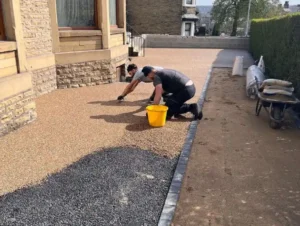
Professional teams normally divide the area into measured sections and calculate how many resin-and-aggregate mixes are required. Edging is set at the intended finished height, giving the trowelling team a consistent level to work towards.
Ask these questions before accepting a quote:
- What depth will the resin be laid at?
- Which manufacturer’s system will be used?
- How many square metres should each mix cover?
- What base preparation is included?
- Is the specification suitable for my vehicles?
- What happens if the existing base is unsuitable?
DALTEX specifically advises homeowners to compare the quoted laying depth, resin type and groundwork when assessing competing proposals.
How Thick Should a Resin Bound Driveway Be in Bournemouth?
For most Bournemouth homes used by ordinary cars and light vans, 18mm is a sensible benchmark for resin driveway thickness, provided it matches the manufacturer’s specification and is laid over a suitable base.
The final design should still reflect the property.
An overlay over sound tarmac, a fully permeable new driveway and a parking area used daily by work vans are different projects. Giving all three the same specification without a survey would be poor practice.
BH Resin Bound Specialist should inspect the existing surface, drainage, levels and expected traffic before confirming the laying depth and complete driveway construction.
Frequently Asked Questions
What Is the Minimum Thickness for a Resin-Bound Driveway?
Eighteen millimetres is a common manufacturer-backed specification for domestic vehicular installations. The exact requirement depends on the system, aggregate and expected traffic.
Can a Resin Driveway Be 15mm Thick?
A 15mm surface may be suitable for some pedestrian applications. For vehicle traffic, ask whether that depth is specifically approved by the resin manufacturer.
Is a 20mm Resin Driveway Better Than an 18mm One?
Not automatically. A 20mm specification may suit a particular aggregate or loading requirement, but quality also depends on the resin ratio, base, mixing and workmanship.
How Deep Is the Full Driveway Construction?
The visible resin layer may be approximately 18mm, but the complete driveway is much deeper because it includes the base and sub-base.
Should Resin Depth Be Included in the Quote?
Yes. The quotation should identify the resin depth, aggregate, resin system and base preparation so you can compare contractors properly.
Get a Proper Driveway Specification
Correct resin driveway thickness matters, but it is only one part of a durable installation. A sound base, suitable drainage, the correct resin-to-aggregate ratio and consistent trowelling are equally important.
BH Resin Bound Specialist provides site assessments for homeowners across Bournemouth. The existing surface, intended vehicle use and drainage can be checked before the depth and full construction are confirmed.