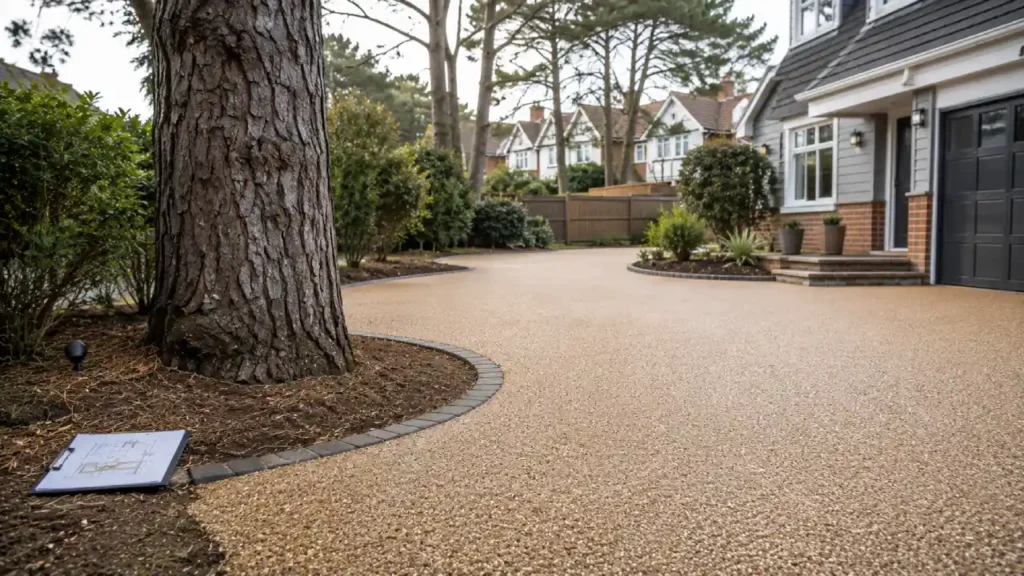
Yes, you can usually lay a resin driveway around a mature tree in Bournemouth. But if the tree is covered by a Tree Preservation Order or stands in a conservation area, you will often need permission from BCP Council first, and the work has to be done in a way that protects the roots. Get those two things right and you can have a smart new driveway without losing the tree, and without a letter from the council. This guide explains the rules, the risks to both the tree and the surface, and the method that keeps both safe.
Can you lay a resin driveway around a protected tree in Bournemouth?
In most cases, yes. The deciding factors are whether the tree is legally protected and how the ground around its roots is treated.
If the tree has a Tree Preservation Order (a TPO), or it sits within one of Bournemouth’s conservation areas, you cannot dig, cut roots, or change ground levels nearby without going through the council. Even where no protection applies, a tree worth keeping needs the right surface and the right groundwork, or you risk damaging it or your new driveway. The good news is that resin bound surfacing is one of the better choices for a plot with a mature tree, because it lets water and air reach the roots. More on that further down.
What is a Tree Preservation Order (TPO)?
A Tree Preservation Order is a legal protection made by the local planning authority that makes it an offence to cut down, top, lop, uproot, or wilfully damage a tree without the council’s written consent.
TPOs come from the Town and Country Planning Act 1990, with the detail set out in the Town and Country Planning (Tree Preservation) (England) Regulations 2012. In Bournemouth, the local planning authority is BCP Council (Bournemouth, Christchurch and Poole). A TPO can cover a single tree, a group of trees, or a whole woodland, and it stays with the land even after a property changes hands.
How do I check if my tree has a TPO in Bournemouth?
Check the tree constraints layer on the BCP Council planning map, then confirm with the council’s tree officer if you are unsure.
You can search the council’s online mapping for protected trees and conservation area boundaries. If the result is not clear, contact the tree officer directly and give them your address. It is worth doing this before you spend money on quotes, because a protected tree changes what is possible and adds a consent step to the timeline.
Trees in Bournemouth conservation areas
Trees in a conservation area are protected automatically, even without a TPO. You must give the council six weeks’ written notice before doing any work to a tree of a certain size, which gives them time to decide whether to make a TPO.
Several Bournemouth neighbourhoods sit within conservation areas, including parts of Talbot Woods and Branksome Park, where mature trees are part of the character the designation is meant to keep. If your home is in one of these areas, treat any tree near your driveway as protected until the council tells you otherwise.
Are Bournemouth’s pine trees protected?
Many of them are. Bournemouth grew up around its pines, and the council protects a large number of them through TPOs and conservation area status.
The trees you are most likely to find on a Bournemouth plot are Scots pine (Pinus sylvestris), Maritime pine (Pinus pinaster), and Monterey pine (Pinus radiata). Pines have wide, shallow root systems that spread well beyond the trunk, which is exactly why they need careful handling during driveway work. A tree being a pine does not automatically mean it is protected, but given how often Bournemouth’s pines carry a TPO, it is safest to check rather than assume.
Do you need permission or consent for a driveway around a protected tree?
There are two separate questions here, and it helps to keep them apart. One is whether the tree is protected. The other is whether the driveway itself needs planning permission.
If the tree is protected, you need the council’s consent for any work that affects it, including digging within its rooting area or changing ground levels over the roots. Separately, paving your front garden may need planning permission depending on size and drainage. As a rule, you do not need planning permission for a hard surface of any size if it lets water drain through, such as a permeable resin bound surface, or if rainwater runs off onto a lawn or border rather than into the road. If you cover more than five square metres with a surface that water cannot pass through, and the water drains to the highway, you will usually need permission.
For a fuller breakdown, see our guides on [planning permission for a resin driveway in BCP] and [permeable, SuDS-friendly resin surfaces].
Can tree roots damage a resin driveway, and can a driveway harm the tree?
The risk runs both ways. Roots can push a surface upwards over time, and building badly over roots can slowly kill the tree.
When roots grow and thicken, they can lift a rigid surface and crack it, a problem known as root heave. At the same time, the way many driveways are built, by digging out the ground and compacting a hard base, cuts roots and squeezes air and water out of the soil. A tree starved of air and water can decline over several years. A permeable resin bound surface helps on both counts: it flexes better than concrete, and because it lets rain and air through, the roots underneath keep getting what they need.
Bournemouth’s free-draining sandy soil is part of the picture too, which we cover in our guide to [sandy soil and drainage in Bournemouth].
Will pine tree roots lift a resin driveway?
They can, if the surface is laid too close to the trunk or over large roots near the surface. Pine roots spread wide and sit fairly shallow, so the safest approach is to keep the build off the main roots and use a surface that gives a little rather than cracking.
Can building a driveway kill a tree?
Yes, although it rarely happens overnight. The usual cause is cutting too many roots, compacting the soil, or burying the base of the trunk under a new surface. A tree can take several years to show the damage, by which point it is often too late to save it. This is why the method matters as much as the material.
What is a Root Protection Area, and how close can you build?
A Root Protection Area is the zone around a tree where the roots need to be left undisturbed for the tree to stay healthy. As a guide, it covers a circle whose radius is roughly twelve times the width of the trunk, measured just above the base.
This figure comes from BS 5837:2012, the British Standard for trees on building and landscaping sites. So a tree with a trunk thirty centimetres wide has a Root Protection Area reaching out about three and a half metres in every direction. The edge of the tree’s canopy, the drip line, is another rough marker for where the important roots lie. The closer you need to build to a tree, the more care the job takes, and the more likely you are to need a specialist to plan it.
How to build a resin driveway around tree roots without harming the tree
The answer is a no-dig build, which means putting the new driveway on top of the ground rather than excavating into the root zone. Here is how a careful installation works.
- Survey first. An arborist, or tree specialist, assesses the tree, marks the Root Protection Area, and agrees what can be done. If the tree is protected, this feeds into the council application.
- Avoid digging in the root zone. Within the protected area, the ground is left largely as it is. Any digging that cannot be avoided is done by hand, not by machine, so roots can be worked around rather than cut.
- Lay a load-spreading base on top. A cellular confinement system, a honeycomb-like grid filled with stone, spreads the weight of cars across the surface so the soil below is not compacted. A geotextile membrane, a tough fabric layer, separates the ground from the new stone.
- Build up the levels carefully. The surface is raised gently rather than dug down, keeping the base of the trunk clear so it is never buried.
- Finish with permeable resin bound stone. This porous top layer lets rain soak through to the roots and gives a clean, even finish.
On a protected tree, much of this is set out in writing for the council before work starts. Done properly, the tree is fenced off and looked after throughout.
Resin bound, resin bonded, or block paving near trees?
For a plot with a mature tree, resin bound is usually the strongest choice. The table below shows why.
| Resin bound | Resin bonded | Block paving | |
|---|---|---|---|
| Lets water and air reach roots | Yes, fully porous | No | Only through the joints |
| Copes with slight ground movement | Good | Moderate | Blocks can lift and rock |
| Smooth, joint-free finish | Yes | Yes | No, many joints |
| Weeds through the surface | Rare | Rare | Common in joints |
Resin bound mixes the stone all the way through and leaves tiny gaps for water to pass, which is what makes it kind to roots. Resin bonded scatters stone over a sealed base, so it looks similar but water cannot get through. Block paving can shift and crack as roots move beneath it. For more detail, see [resin bound versus resin bonded] and [resin versus block paving].
The professional process: surveys, the arborist, and council sign-off
A driveway near a protected tree is planned on paper before anyone lifts a spade. Three documents do most of the work, all based on BS 5837:2012.
The first is an arboricultural impact assessment, which sets out how the driveway might affect the tree. The second is an arboricultural method statement, which describes exactly how the work will be done to keep the tree safe. The third is a tree protection plan, a drawing showing the protected area and where the fencing goes. These are usually prepared by an arboricultural consultant, often a member of the Arboricultural Association, and signed off by the council’s tree officer. A good driveway company will either handle this for you or work alongside the specialist who does.
What happens if you damage or remove a protected tree?
It is a criminal offence, and the fines are serious. Cutting down or wilfully destroying a protected tree without consent can lead to a fine running into thousands of pounds, and in the most serious cases the fine is unlimited.
Lesser damage, such as careless work that harms a protected tree, can also bring a fine. The council can require you to plant a replacement tree as well. Because the penalties under the Town and Country Planning Act 1990 are high, and the exact figures are updated from time to time, always confirm the current position with BCP Council before any work begins. Treating the rules with respect protects your wallet as much as the tree.
A tree-lined plot is not a problem, it is a feature
A mature tree on your front garden is part of what makes a Bournemouth home worth living in, and you do not have to choose between keeping it and having a proper driveway. With the right checks, the right consent, and a no-dig resin bound build, you can have both. If you have a protected tree and want to know what is possible on your plot, we offer a free survey and will tell you honestly where you stand.
Frequently asked questions
Do I need permission to build a driveway around a protected tree?
You need the council’s consent for any work that affects a protected tree, including digging near its roots or changing ground levels. The driveway surface itself may also need planning permission depending on its size and how it drains.
Can tree roots damage a resin driveway?
They can lift and crack a surface laid too close to a tree or directly over large roots. A permeable resin bound surface laid using a no-dig method copes with this far better than rigid materials.
How close to a tree can you lay a resin driveway?
As a guide, stay outside the Root Protection Area, a circle with a radius of about twelve times the trunk width. The closer you build, the more specialist planning the job needs.
Are Bournemouth’s pine trees protected?
Many are, through Tree Preservation Orders or conservation area status. Always check with BCP Council before assuming you can work near one.
How do I check if my tree has a TPO?
Search the protected tree layer on the BCP Council planning map, then confirm with the council’s tree officer if the result is unclear.